TMI Research Associate
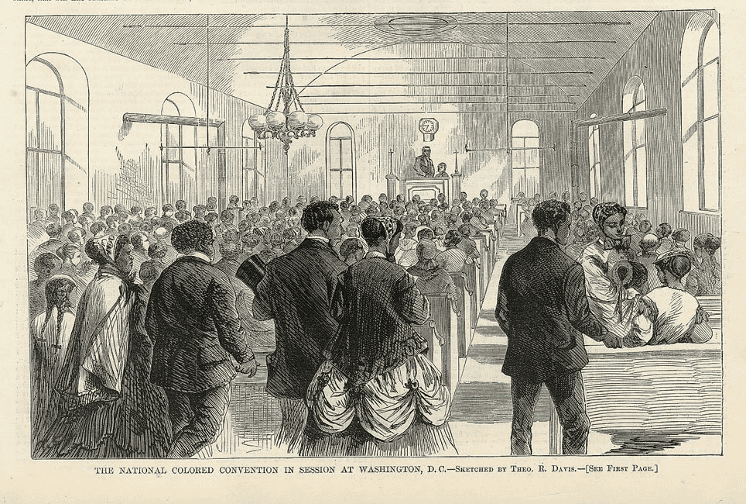
The 250th anniversary of the United States raises questions such as: What does it mean to be a citizen? Who can lay claim to U.S. citizenship, and on what basis? What qualifies as civil rights, and why are they needed? To commemorate this milestone and to answer these questions, this brief examines the meaning of citizenship by exploring the lesser-known story of the Colored Conventions Movement (CCM).
This brief comes at a critical moment in the nation’s history — a moment when the humanity, citizenship status, and civil rights of millions of people hang in the balance. Ultimately, this brief contends that the history of the CCM and the perspectives of free and formerly enslaved Black delegates in the 19th century can guide today’s understanding about the meaning of citizenship and belonging in the United States.
Focusing on annual national conventions held between 1830 and 1869, this brief explores the history and legacy of the CCM, which coordinated political gatherings of free and formerly enslaved Black people in the 19th century.
The CCM embodied the inclusive vision of citizenship that it sought to create — one that welcomed people with different backgrounds, occupations, and thoughts. The movement included women, free-born and formerly enslaved people, and workers from a range of occupations.
Black delegates’ understanding of citizenship emerged from a counternarrative about the nation’s founding that established a person’s meaningful contributions — not their racial identity — as the determinant of their citizenship.
Free Black people’s understanding of and commitment to citizenship motivated them to make certain demands of the national government. These demands — to abolish slavery, legally recognize Black people’s full citizenship, and commit to protecting equal citizenship through the provision of civil rights — were later realized through the ratification of the Reconstruction Amendments.
The delegates viewed civil rights as necessary tools for protecting freedom for all, which could not exist in a society that allowed any group to dominate another socially, economically, or politically.
The Black delegates of the CCM envisioned a multi-racial, multi-ethnic democracy that safeguards human dignity, holds an expansive view of citizenship, and advances equal access to opportunities for all.
Congress must completely abolish slavery in the United States. When Congress passed the 13th Amendment in 1865, it created a loophole for the continuation of slavery; the exceptions clause states that involuntary servitude is legal as a punishment for a crime.
Legal advocates must disrupt efforts to abolish birthright citizenship.
State and local lawmakers must pass laws that guarantee access to historically accurate curricula and inclusive learning materials.
State legislatures should enact State Voting Rights Acts that:
Additionally, states and local jurisdictions should explore structural electoral changes, such as proportional multi-winner ranked choice-voting and single-winner ranked-choice voting, to ensure that Black voters have an equal opportunity to elect candidates of their choice.
What does it mean to be a citizen? Who can lay claim to U.S. citizenship, and on what basis? What qualifies as civil rights, and why are they needed? These questions are as relevant today as they were when the Black delegates of the CCM gathered to discuss them at annual conventions during the 19th century. The history of the CCM provides salient lessons for the continued struggle for human dignity, racial justice, and equality. Following the example of the CCM delegates, the United States must adopt an expansive understanding of citizenship that advances equality and safeguards freedom and dignity.

Frances Ellen Watkins Harper1Preeya Waite, Colored Convention Heartland: Black Organizers, Women and the Ohio Movement – Frances Ellen Watkins Harper, Colored Conventions Project (Nancy Yerian ed. 2016), https://coloredconventions.org/ohio-organizing/biographies/frances-ellen-watkins-harper/ (last visited Feb. 4, 2026); Michael Stancliff, Frances Ellen Watkins Harper: African American Reform Rhetoric and the Rise of a Modern Nation State(Routledge 2011), http://ndl.ethernet.edu.et/bitstream/123456789/10058/1/162.pdf.pdf; Temple Univ. Librs., William Still: An African American Abolitionist – Harper, Frances Ellen Watkins, in Philadelphia’s Guide: African-American State Historical Markers (Charles L. Blockson ed., 1992), https://exhibits.temple.edu/s/william-still/page/harper–frances-ellen-watkins (last visited Feb. 11, 2026); Ctr. for Black Digit. Rsch., Black Women’s Organizing Archive: Frances E. W. Harper, https://bwoaproject.org/harper/ (last visited Feb. 4, 2026).
Date of Birth: September 24, 1825
Birthplace: Baltimore, Maryland
Status at Birth: Born free to free parents
Education: Formally educated and later self-educated
Occupations: Seamstress, domestic worker, author, poet, abolitionist, educator, lecturer, and activist
Ideological Leaning: Moral persuasion, and proponent of social uplift and temperance

Frederick Douglass2The Trinity Forum, Excerpts from Narrative of the Life of Frederick Douglass (2020), https://publicsquareforum.org/wp-content/uploads/2023/12/Douglass-Reading.pdf; Cornell Univ. Libr.,
Uplift and Political Action, Black Print: African American Writing, 1773-1910, https://exhibits.library.cornell.edu/blackprint/feature/uplift-and-political-action (last visited Feb. 4, 2026); Frederick Douglass, Britannica.com, https://www.britannica.com/biography/Frederick-Douglass (last visited Feb. 4, 2026).
Date of Birth: February 1818
Birthplace: Talbot County, Maryland
Status at Birth: Born enslaved, self-manumitted as a young adult
Education: Self-educated3He learned to read from some of the Irish immigrant children on his street during his enslavement in Baltimore. He traded bread for lessons.
Occupations: Chimney sweeper, orator, abolitionist, activist, publisher, and writer
Ideological Leaning: Moral persuasion, moral and racial uplift,4See Cornell Univ. Libr., supra note 42. and eventually adopted direct political activism

Reverend Henry Highland Garnet5W. M. Brewer, Henry Highland Garnet, J. Negro Hist. (n.d.), https://www.journals.uchicago.edu/doi/pdf/10.2307/2713912 (last visited Feb., 6, 2026).
Date of Birth: December 23, 1815
Birthplace: New Market, Maryland
Status at Birth: Born enslaved, self-manumitted as a child
Education: Formally educated
Occupations: Seaman, pastor, abolitionist, lecturer, and activist
Ideological Leaning: Direct political activism, and advocated for armed resistance against slavery
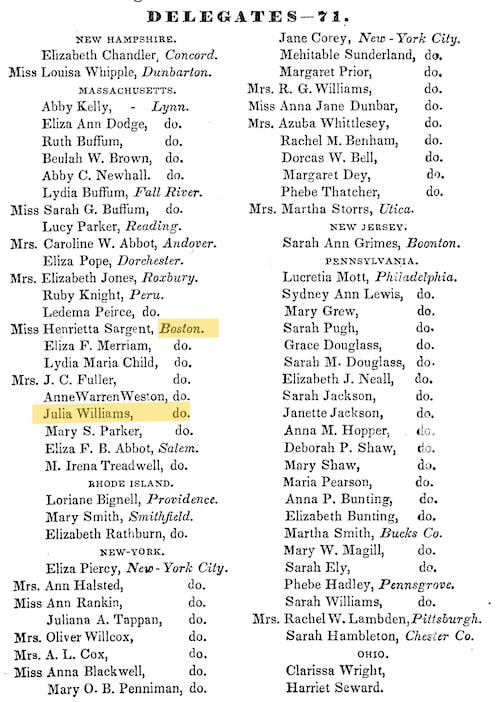
Julia Williams Garnet6Nat’l Park Serv., Person: Julia Williams Garnet, https://www.nps.gov/people/julia-williams-garnet.htm (last visited Feb. 4, 2026); Holly A. Pinheiro, Jr., Julia W. Garnet’s Civil War Activism, Black Persps. (Afr. Am. Intell. Hist. Soc’y Dec. 14, 2022), https://www.aaihs.org/julia-w-garnets-civil-war-activism/ (last visited Feb. 5, 2026);Colored Conventions Project, Prosperity and Politics: Taking Stock of Black Wealth and the 1843 Convention, Julia Williams Garnet, https://coloredconventions.org/black-wealth/biographies/julia-williams-garnet/ (last visited Feb. 4, 2026).
Date of Birth: July 1, 1811
Birthplace: Charleston, South Carolina
Status at Birth: Unknown
Education: Formally educated
Occupations: Educator, abolitionist, and activist
Ideological Leaning: Direct political activism, and advocated for armed resistance against slavery

Martin Delany7Nick Palombo, To Stay Or To Go? The National Emigration Convention of 1854: Delving into Martin Delany, Colored Conventions Project (Sarah Patterson ed. 2016), https://coloredconventions.org/emigration-debate/martin-delany/ (last visited Feb. 4, 2026)
Date of Birth: May 6, 1812
Birthplace: Charles Town, Virginia (later West Virginia)
Status at Birth: Born free to a free mother and enslaved father who eventually purchased his freedom
Education: Informally homeschooled and pursued formal education
Occupations: Physician, writer, editor, abolitionist, and officer in the U.S. Army (Civil War veteran8Sachi Shepherd, February, 1865: Martin Delany Becomes the First Black Major in the US Army, S.C. Hist. Soc’y (Feb. 4, 2025), https://schistory.org/february1865-martin-delany-becomes-the-first-black-major-in-the-us-army/ (last visited Feb. 4 ,2026).)
Ideological Leaning: Direct political activism, advocate of armed resistance, and supporter of Black-led emigration

Mary Ann Shadd Cary9Nat’l Women’s Hall of Fame, Mary Ann Shadd Cary, https://www.womenofthehall.org/inductee/mary-ann-shadd-cary/ (last visited Feb. 4, 2026); Elizabth Andrews, Remembering Mary Ann Shadd Cary, Burgundy Asset Mgmt. Ltd. (Mar. 2024), https://www.burgundyasset.com/wp-content/uploads/Remembering-Mary-Ann-Shadd-Cary.pdf;, Preeya Waite, Colored Convention Heartland: Black Organizers, Women and the Ohio Movement, Colored Conventions Project (Nancy Yerian ed. 2016), https://coloredconventions.org/ohio-organizing/biographies/frances-ellen-watkins-harper/ (last visited Feb. 4, 2026).
Date of Birth: 1823
Birthplace: Wilmington, Delaware
Status at Birth: Born free to formerly enslaved parents
Education: Formally educated
Occupations: Lawyer, educator, publisher, abolitionist, suffragette, and activist
Ideological Leaning: Direct political activism, and supporter of Black-led emigration

Reverend Samuel Cornish10Jasmine Holmes, Rev. Samuel Eli Cornish, Afr. Am. Ministries (2022), https://aampca.org/person/rev-samuel-eli-cornish/ (last visited Feb. 4, 2026); The N.Y. Afr. Free Sch. Collection, Samuel E. Cornish, N.Y. Hist. Soc’y(n.d.), https://www.nyhistory.org/web/africanfreeschool/bios/index.html (last visited Feb. 5, 2026); Colored Conventions Project, Digital Records, Minutes and Proceedings of the Second Annual Convention for the Improvement of the Free People of Color in these United States (Benj. Paschal, Thos. Butler & Jas C. Matthews Publ’g Co., 1832), https://omeka.coloredconventions.org/items/show/229 (last visited Feb. 6, 2026) (hereinafter the “1832 Convention”).
Date of Birth: 1795
Birthplace: Sussex County, Delaware
Status at Birth: Born free to free parents
Education: Formally educated
Occupations: Minister, abolitionist, community organizer, journalist, and newspaper editor
Ideological Leaning: Moral persuasionist

Reverend Theodore S. Wright11Joseph Yannielli, White Supremacy at the Commencement of 1836, Princeton & Slavery Project, https://slavery.princeton.edu/stories/white-supremacy-at-commencement (last visited Feb. 6, 2026); Colored Conventions Project, Digital Records, Minutes of the National Convention of Colored Citizens: Held at Buffalo,
on the 15th, 16th, 17th, 18th, and 19th of August, 1843; for the purpose of considering their moral and political condition as American Citizens (Piercy & Reed, 1843), https://omeka.coloredconventions.org/files/original/73369fab9bb261275b57276ccbdbded2.pdf (hereinafter the “1843 Convention).
Date of Birth: 1797
Birthplace: Providence, Rhode Island
Status at Birth: Born free to free parents
Education: Formally educated
Occupations: Writer, editor, abolitionist, minister, and community organizer
Ideological Leaning: Direct political activism
