TMI Research Associate
In the lead-up to the 2026 midterm elections, racial disinformation will likely be used as a political tool to build public support for exclusionary and inequitable policies. As U.S. voters get ready to cast their ballots, they must be prepared to identify, expose, and disempower racial disinformation and those who spread it.
“Demystifying Racial Disinformation” explains what racial disinformation is, why people spread it, and how it harms multi-racial democracy. By recounting the history of anti-Black racial disinformation in mass media, this Brief ultimately equips people with the knowledge needed to (1) recognize racial disinformation in whatever form it takes, (2) understand its relationship to social inequality, and (3) disrupt its spread, in defense of democracy.
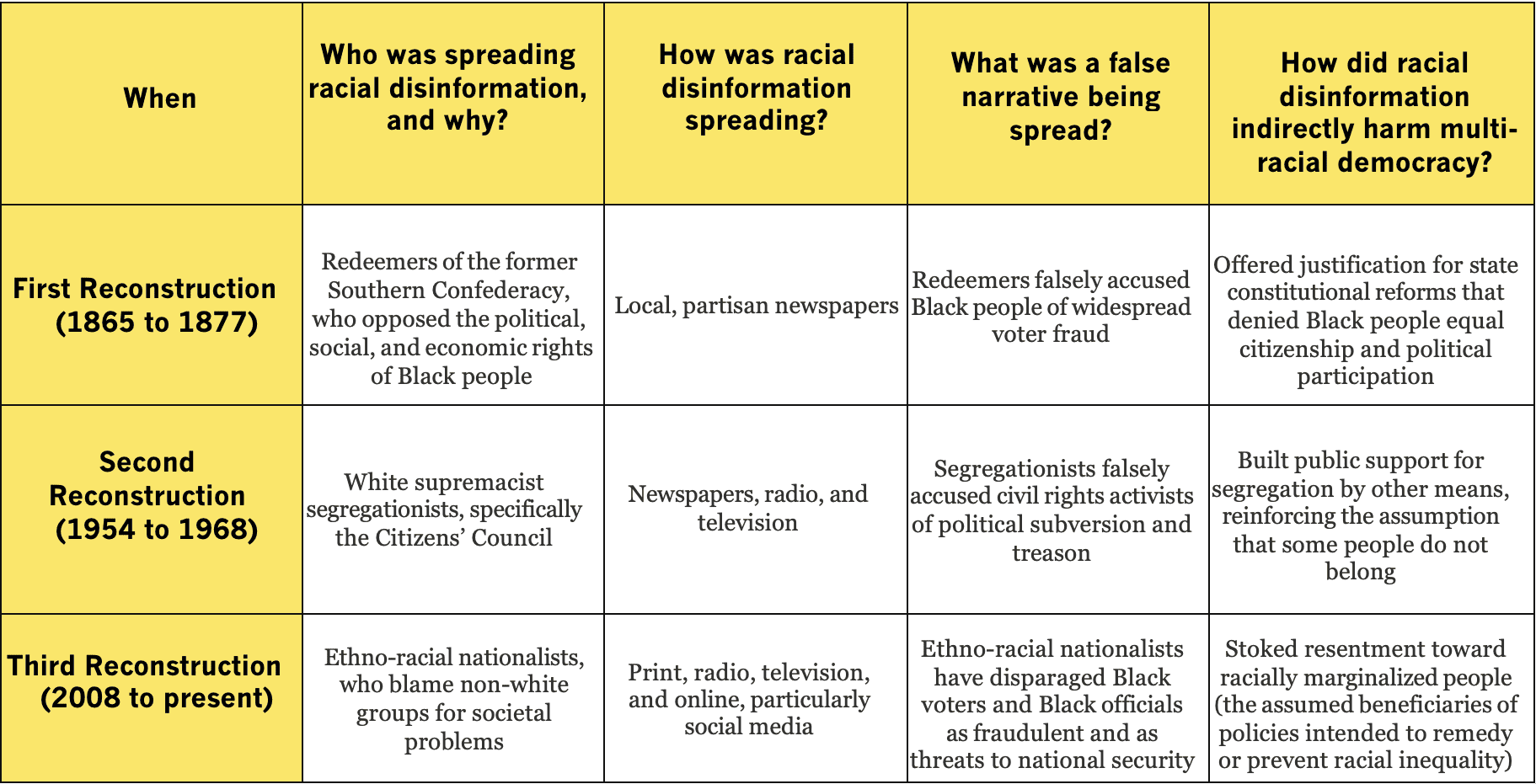
TMI analyzed case studies of racial disinformation in the First Reconstruction Era (1865 to 1877), the Second Reconstruction Era (1954 to 1968), and the Third Reconstruction Era (2008 to the present). TMI learned that:
Racial disinformation targets racially marginalized groups whose presence poses a perceived threat to the inequitable institutions, practices, and social norms that benefit groups who have more power. Peddlers of racial disinformation use stereotypes, racial tropes, and myths to dehumanize specific groups of people, reinforcing the false idea that they are less moral, intelligent, or competent—and therefore not entitled to equal rights. Over time, innovations in mass media have increased racial disinformation’s ability to reach larger audiences.
People who benefit from existing social inequality often use racial disinformation to either justify their power or regain control when social and political orders are suddenly challenged. Political figures, wealthy interest groups, and state actors typically respond to efforts to make society more equal by spreading racial disinformation that supports the preservation of the status quo.
Racial disinformation threatens democracy because it undermines the principle of equality and the practice of collective deliberation. A basic prerequisite for democracy is the shared understanding that members of a society are equal and free. People who do not see one another as equals will lack the mutual respect needed to work together toward a collective goal.
To counter the ongoing spread and harmful effects of racial disinformation, policymakers should enact the following measures:
Federal and state lawmakers should utilize tax benefits to incentivize both the establishment and support of local news outlets.
Federal, state, and local policymakers should subsidize media outlets that serve Black communities and other racially marginalized communities.
Federal lawmakers should reinstate the ability of both the Corporation for Public Broadcasting (CPB) and federal agencies to fund National Public Radio (NPR) and the Public Broadcasting Service (PBS).
Federal policymakers should levy what media policy and politics scholar Victor Pickard, PhD, calls a “public media tax” on the revenues of social media and tech companies that facilitate and benefit from the spread of disinformation.
State and local lawmakers should preserve the integrity of public education by passing laws that guarantee access to historically accurate curricula and inclusive learning materials.

Demystifying Racial Disinformation Brief
The United States is experiencing a constitutional crisis, economic uncertainty, and widening social divisions. Amid anxiety- and fear-inducing moments such as this, racial disinformation spreads through mass media and amplifies dehumanizing mischaracterizations of racially marginalized groups. Beneficiaries of the status quo and opportunists in pursuit of power spread racial disinformation to justify the exclusion and subordination of people based on their race, ethnicity, and ancestry. They callously exploit the fears and insecurities of their audiences to build public opposition to policies that would advance equal rights and access to opportunity for all.
Still, there is a way forward. It is the duty of the public to work together and relentlessly pressure political representatives into fighting for democracy. Now is the time to disrupt racial disinformation by demanding increased support for local journalism, robust funding for public media, accountability measures for social media platforms, and historically accurate and inclusive public education.
